
We set up e-invoicing and local tax in SAP for Saudi Arabia, the UAE, India and Egypt: one setup, tested against each authority’s rules, and monitored after go-live.
Is your SAP ready for e-invoicing?
Choose a country and answer a few questions. You get a readiness score, your gaps and what to do next.
Phase 2 connects your invoicing system to ZATCA’s FATOORA platform, wave by wave, with at least six months’ notice.
- Do you know your Phase 2 integration wave and date?
- Does SAP produce invoices in the required XML (UBL) format with QR code?
- Are invoices stamped (cryptographic stamp, UUID and previous-invoice hash)?
- Is SAP connected to FATOORA for clearance (B2B) and reporting within 24 hours (simplified)?
- Is someone alerted when ZATCA rejects an invoice?
A Peppol-based model: invoices go through an Accredited Service Provider (ASP), with data reported to the Federal Tax Authority. B2B and B2G are in scope.
- Have you appointed an Accredited Service Provider (ASP)?
- Is your SAP invoice data mapped to the UAE data model (PINT AE)?
- Are customer TRNs and master data complete and correct?
- Have you planned end-to-end testing before your go-live date?
GST e-invoicing applies to businesses with annual turnover above ₹5 crore. Invoices are registered on the IRP, which returns an IRN and signed QR code.
- Are IRN and QR codes generated automatically from SAP?
- Are invoices validated before they are sent to the IRP?
- Are e-way bills generated and linked to deliveries?
B2B e-invoicing through the Egyptian Tax Authority is mandatory for VAT-registered businesses; paper invoices are no longer valid for VAT.
- Are e-invoices submitted to the ETA straight from SAP?
- Is your digital signature set up?
- Are your products mapped to the required codes?
- Are you ready for e-receipts on B2C sales?
Your gaps, and what INK sets up in SAP
Indicative only, based on public announcements as of October 2026. Always confirm your obligations with your tax adviser.
4 countries
Saudi Arabia, UAE, India and Egypt, where INK has offices
One setup
one SAP design for every tax authority you report to
Tested
against each authority’s rules before go-live
Monitored
rejections caught and fixed after go-live
E-invoicing is no longer a reporting task at month-end. In more and more countries, an invoice is not valid until the tax authority has accepted it.
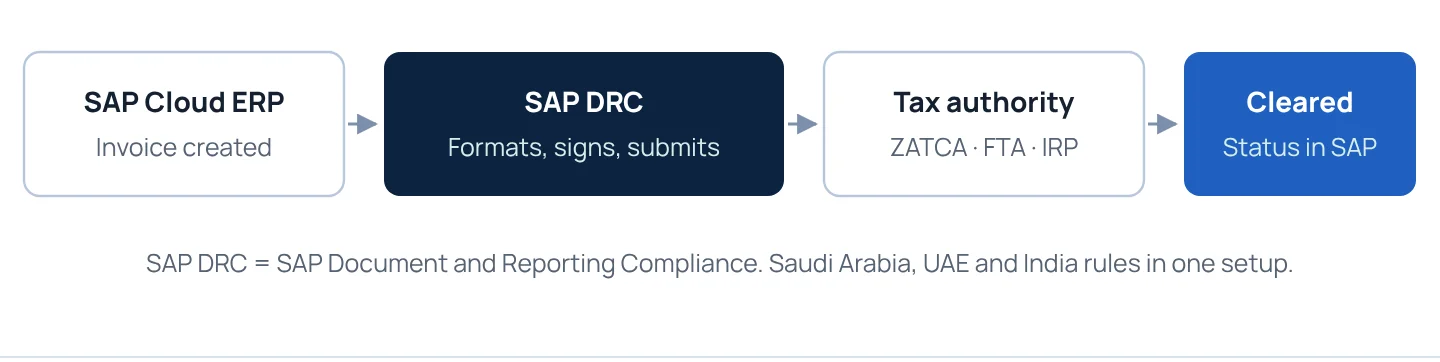
One SAP setup for every tax authority
Invoices flow from SAP through one compliance layer to each country’s tax authority or network.
Country requirements at a glance
Choose a country to see what the law requires today and what INK sets up in SAP. Summary as of October 2026; rules change, so we always confirm the latest requirements with you.
Saudi Arabia (ZATCA)
What the rules require
- Phase 1 (generation) has applied to all VAT taxpayers since December 2021
- Phase 2 (integration) connects your system to ZATCA’s FATOORA platform, wave by wave
- Wave 24 covered taxpayers with VAT-taxable revenue above SAR 375,000, with integration by 30 June 2026; ZATCA notifies each taxpayer when its wave applies
- B2B invoices need real-time clearance; simplified (B2C) invoices are reported within 24 hours
What INK sets up in SAP
- Invoices in the required XML (UBL) format with QR code
- Cryptographic stamp, UUID and previous-invoice hash
- Clearance and reporting integration with FATOORA
- Onboarding of your SAP system with ZATCA and testing in the sandbox
- SAP Document and Reporting Compliance
- S/4HANA
- SAP Cloud ERP
- SAP Integration Suite
The result: Invoices cleared with ZATCA straight from SAP, with rejections caught and fixed.
UAE
What the rules require
- A Peppol-based five-corner model: invoices go through an Accredited Service Provider (ASP), with data reported to the Federal Tax Authority
- Covers B2B and B2G transactions; B2C is out of scope for now
- Pilot from 1 July 2026; mandatory from 1 January 2027 for revenue of AED 50 million or more, from 1 July 2027 for others, and from 1 October 2027 for government entities
- ASP appointment deadline extended to 30 October 2026 for businesses with revenue of AED 50 million or more
What INK sets up in SAP
- Readiness assessment of your invoicing data and processes
- UAE data model (PINT AE) mapping from SAP
- Connection from SAP to your chosen Accredited Service Provider
- End-to-end testing before your mandatory date
- SAP Document and Reporting Compliance
- Peppol
- SAP Integration Suite
The result: Ready for your UAE go-live date, with no last-minute rush.
India (GST)
What the rules require
- GST e-invoicing applies to businesses with annual turnover above ₹5 crore (since August 2023)
- Invoices are registered on the Invoice Registration Portal (IRP), which returns an IRN and signed QR code
- Businesses with turnover of ₹10 crore or more must report invoices to the IRP within 30 days (since April 2025), or the invoice is rejected
- E-way bills are needed for the movement of goods
What INK sets up in SAP
- Automatic IRN and QR code generation from SAP
- Validation before submission, so invoices are reported within the 30-day window
- E-way bill generation linked to deliveries
- GST returns supported with clean, reconciled data
- SAP Document and Reporting Compliance
- S/4HANA
- SAP Cloud ERP
The result: Valid invoices and protected input tax credit for your customers.
Egypt (ETA)
What the rules require
- B2B e-invoicing through the Egyptian Tax Authority is mandatory for VAT-registered businesses; paper invoices are no longer valid for VAT
- Invoices are digitally signed and submitted to the ETA, which validates them with a unique ID
- B2C e-receipts are being rolled out in waves to consumer-facing businesses
- Product codes (GS1 or EGS) are required on invoice lines
What INK sets up in SAP
- E-invoice submission from SAP to the ETA
- Digital signature set-up
- Product code mapping
- E-receipt readiness for B2C sales
- SAP Document and Reporting Compliance
- S/4HANA
- SAP Integration Suite
The result: Invoices and receipts submitted to the ETA straight from SAP, with rejections caught and fixed.
Run and stay compliant
What the rules require
- Invoices rejected by the authority with nobody noticing
- New waves and rule changes every year
- Each country handled by a different tool or partner
What INK sets up in SAP
- One monitor for every submission and rejection
- Alerts and fixes for rejected invoices
- Updates as authorities change their rules
- Multilingual support from iCare AMS
- SAP Document and Reporting Compliance
- iCare AMS
- SAP Cloud ALM
The result: Compliance that keeps up as the rules change.
How we deliver
Assess
Check which rules apply to each of your companies, and your data quality.
You get: A compliance gap list
Design
One SAP design for all your countries.
You get: A signed-off design
Build
Configure SAP and connect to authorities or service providers.
You get: Working integrations
Test
Test against each authority’s sandbox and rules.
You get: Proven compliance
Run
Go live, monitor and keep up with rule changes.
You get: Ongoing compliance
Requirements summarised from public announcements as of October 2026. Always confirm your obligations with your tax adviser. Related: Finance, Treasury & Group Reporting · Integration & APIs · GROW with SAP
Check your e-invoicing readiness
Tell us which countries and companies you operate in. We’ll show you which rules apply and when, and what SAP needs to be ready.
Frequently asked questions
When does UAE e-invoicing become mandatory?
From 1 January 2027 for businesses with revenue of AED 50 million or more, from 1 July 2027 for other businesses, and from 1 October 2027 for government entities. A voluntary pilot started on 1 July 2026, and the deadline for businesses with revenue of AED 50 million or more to appoint an Accredited Service Provider has been extended to 30 October 2026.
What does ZATCA Phase 2 require?
Integration of your invoicing system with ZATCA's FATOORA platform: XML invoices with QR code, cryptographic stamp and hash chain, real-time clearance for B2B invoices and reporting within 24 hours for simplified invoices. ZATCA brings taxpayers in by waves and gives at least six months' notice.
Who needs GST e-invoicing in India?
Businesses with annual turnover above ₹5 crore. Since April 2025, businesses with turnover of ₹10 crore or more must report invoices to the IRP within 30 days of the invoice date.
Which SAP solution do you use?
Usually SAP Document and Reporting Compliance, which supports e-invoicing for many countries from S/4HANA and SAP Cloud ERP, connected through SAP Integration Suite or an accredited provider where required.
Do these rules change?
Yes, often. This page summarises public announcements as of October 2026. We confirm the latest rules with you and your tax adviser at the start of every project.